jenetics
Jenetics 是一款基于现代 Java 编写的进化计算库,专注于提供遗传算法、遗传规划、语法演化及多目标优化等核心功能。它旨在帮助开发者高效解决复杂的优化难题,无论是寻找函数的最小值还是最大值,都能在不需手动调整底层算法细节的情况下自动完成。
这款工具特别适合软件工程师、数据科学家及学术研究人员使用,尤其是那些需要在 Java 生态中构建智能优化系统或进行算法实验的群体。Jenetics 的独特之处在于其清晰的架构设计,将基因、染色体、种群等概念进行了明确分离,使得代码逻辑直观易懂。更值得一提的是,它创新性地引入了“进化流”(EvolutionStream)机制,完美契合 Java Stream API 的操作习惯。这意味着用户可以像处理普通数据流一样,通过简洁的链式调用来执行复杂的进化步骤,极大地提升了开发效率与代码的可读性。此外,Jenetics 还提供了丰富的扩展模块,支持非标准遗传操作及多目标问题求解,并配有详尽的文档与用户手册,是 Java 领域进行进化算法开发的强力助手。
使用场景
某金融科技团队正在开发高频交易策略,需要从数千个技术指标参数组合中自动寻找收益最大化的最优配置。
没有 jenetics 时
- 开发人员需手动编写复杂的遗传算法底层逻辑,包括基因编码、交叉变异算子及种群管理,代码冗余且极易出错。
- 面对多目标优化(如同时最大化收益并最小化回撤)时,缺乏现成框架支持,只能硬编码启发式规则,导致策略收敛缓慢。
- 难以利用 Java Stream API 进行并行计算优化,每次全量回测耗时数小时,严重拖慢迭代节奏。
- 调整适应度函数往往需要重构核心演化流程,耦合度高,无法灵活应对市场风格切换。
使用 jenetics 后
- 直接调用 Jenetics 预定义的
Gene、Chromosome和Engine组件,几行代码即可构建标准的演化流,将核心算法开发时间从数周缩短至几天。 - 利用
jenetics.ext模块原生支持的多目标优化算法(MOEA),轻松平衡收益与风险,无需自行设计复杂的权重评分机制。 - 基于
EvolutionStream无缝集成 Java Stream API,天然支持并行处理,将大规模参数空间的搜索效率提升数倍。 - 适应度函数与演化逻辑完全解耦,修改策略评估标准只需替换函数实现,无需触碰底层演化引擎,极大提升了实验灵活性。
Jenetics 通过标准化的演化流设计和模块化架构,让复杂的全局优化问题变得像编写普通 Java 流处理一样简单高效。
运行环境要求
- Linux
- macOS
- Windows
未说明
未说明
快速开始
Jenetics



Jenetics 是一个基于现代 Java 编写的 遗传算法、进化算法、语法进化、遗传编程 和 多目标优化 库。它采用清晰的模块化设计,将算法中的各个概念明确分离,例如 基因、染色体、基因型、表现型、种群 以及适应度 函数。Jenetics 允许您在无需调整适应度函数的情况下,直接对其进行最小化或最大化操作。与其他遗传算法实现不同,该库使用进化流(EvolutionStream)的概念来执行进化步骤。由于 EvolutionStream 实现了 Java Stream 接口,因此它可以与 Java Stream API 的其他部分无缝协作。
其他语言
- Jenetics.Net:用 C# 编写的实验性 .NET Core 版本的基础库移植。
- Helisa:Jenetics 库的 Scala 封装。
星标历史

文档
构建 Jenetics
Jenetics 至少需要 Java 25 才能编译和运行。
从 GitHub 克隆主分支:
$ git clone https://github.com/jenetics/jenetics.git <builddir>
Jenetics 使用 Gradle 作为构建系统,并将源代码组织成多个子项目(模块)。每个子项目都位于其各自的子目录中:
已发布的项目
以下项目/模块也已发布到 Maven 中心仓库:
- jenetics :该项目包含 Jenetics 核心模块的源代码和测试。
- jenetics.ext :该模块包含额外的非标准遗传算法操作和数据类型。它还包含用于解决多目标问题(MOEA)和进行语法进化的类。
- jenetics.prog :这些模块包含用于执行遗传编程(GP)的类。它们可以与现有的
EvolutionStream和进化引擎无缝集成。 - jenetics.xml :这是用于 Jenetics 基础数据结构的 XML 序列化模块。
未发布的模块
- jenetics.distassert:该模块用于测试样本数据是否符合给定的统计分布。Jenetics 使用此模块来测试其遗传算法算子。
- jenetics.example:该模块包含核心模块的示例代码。
- jenetics.doc:包含网站和手册的代码。
- jenetics.tool:该模块包含用于集成测试和算法性能测试的类。它还用于创建遗传算法性能指标以及根据性能指标生成图表。
要构建库,请进入 <builddir> 目录(或其中一个模块目录),然后运行以下任务之一:
- compileJava:编译 Jenetics 源代码,并将编译后的类文件复制到
<builddir>/<module-dir>/build/classes/main目录。 - jar:编译源代码并生成 JAR 文件。生成的工件会被复制到
<builddir>/<module-dir>/build/libs目录。 - javadoc:生成 API 文档。Javadoc 存储在
<builddir>/<module-dir>/build/docs目录中。 - test:编译并运行单元测试。测试结果会打印到控制台,同时由 TestNG 生成的测试报告会被写入
<builddir>/<module-dir>目录。 - clean:删除
<builddir>/build/*目录,并移除所有生成的工件。
要从源代码构建库的 JAR 文件,请执行以下命令:
$ cd <build-dir>
$ ./gradlew jar
示例
你好,世界(统计1的个数)
最小化的进化引擎设置需要一个基因型工厂 Factory<Genotype<?>> 和一个适应度函数 Function。Genotype 实现了 Factory 接口,因此可以用作创建初始种群和生成新的随机基因型的原型。
import io.jenetics.BitChromosome;
import io.jenetics.BitGene;
import io.jenetics.Genotype;
import io.jenetics.engine.Engine;
import io.jenetics.engine.EvolutionResult;
import io.jenetics.util.Factory;

public class HelloWorld {
    // 2.) 定义适应度函数。
    private static Integer eval(Genotype<BitGene> gt) {
        return gt.chromosome()
            .as(BitChromosome.class)
            .bitCount();
    }

    public static void main(String[] args) {
        // 1.) 定义适合该问题的基因型(工厂)。
        Factory<Genotype<BitGene>> gtf =
            Genotype.of(BitChromosome.of(10, 0.5));

        // 3.) 创建执行环境。
        Engine<BitGene, Integer> engine = Engine
            .builder(HelloWorld::eval, gtf)
            .build();

        // 4.) 启动执行(进化),并收集结果。
        Genotype<BitGene> result = engine.stream()
            .limit(100)
            .collect(EvolutionResult.toBestGenotype());

        System.out.println("你好,世界:\n" + result);
    }
}
与其他遗传算法实现不同,该库使用进化流(EvolutionStream)的概念来执行进化步骤。由于 EvolutionStream 实现了 Java Stream 接口,它可以与 Java 流式 API 的其他部分无缝协作。现在让我们仔细看看上面的代码,并逐步讨论这个简单的程序:
在设置一个新的进化引擎时,最具有挑战性的部分可能是将问题域转换为合适的基因型(工厂)表示。在我们的示例中,我们希望统计一个
BitChromosome中1的个数。由于我们只统计一个染色体中的1,因此我们只向基因型中添加了一个BitChromosome。一般来说,基因型可以由1到n个染色体组成。一旦完成这一步,就可以定义要最大化的适应度函数。利用 Java 8 引入的新语言特性,我们只需编写一个私有静态方法,该方法接受我们定义的基因型并计算其适应度值。如果我们想使用优化的位计数方法
bitCount(),就必须将Chromosome<BitGene>类强制转换为实际使用的BitChromosome类。由于我们确定基因型是由BitChromosome创建的,因此可以安全地进行此操作。然后将对eval方法的引用用作适应度函数,并传递给Engine.build方法。在第三步中,我们创建了进化引擎,它负责改变或进化给定的群体。引擎具有高度可配置性,可以设置参数来控制进化和计算环境。为了改变进化行为,可以设置不同的变异算子和选择算子。通过更改所使用的
Executor服务,可以控制引擎允许使用的线程数量。新的引擎实例只能通过其构建器创建,而构建器是通过调用Engine.builder方法创建的。在最后一步中,我们可以从引擎中创建一个新的进化流。进化流是进化过程的模型或视图,它充当“进程句柄”,并且还允许您控制进化是否终止等。在我们的示例中,我们简单地将流截断为100代。如果不限制流,进化流将不会终止并会永远运行。由于进化流扩展了
java.util.stream.Stream接口,它能够与 Java 流式 API 的其余部分无缝集成。最终结果,即本例中的最佳基因型,随后通过EvolutionResult类预定义的收集器之一收集。
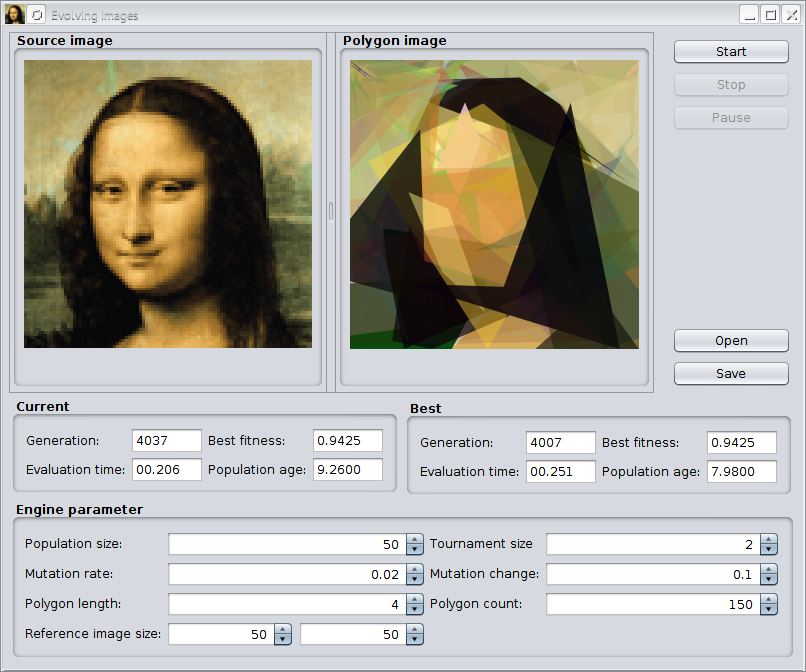
进化图像
这个示例尝试用半透明多边形近似给定的图像。它带有一个 Swing 界面,您可以立即开始自己的实验。在使用以下命令编译源代码后:
$ ./gradlew compileTestJava
您可以通过以下命令启动该示例:
$ ./jrun io.jenetics.example.image.EvolvingImages
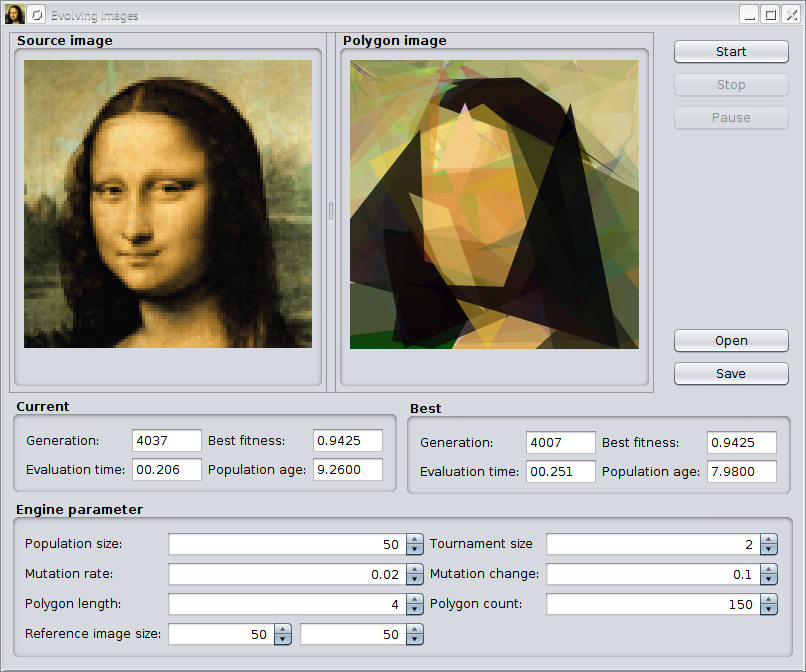
上图显示的是在默认图像进化约4,000代后的 GUI。通过“打开”按钮,可以加载其他图像进行多边形化处理。而“保存”按钮则允许将多边形化的图像以 PNG 格式保存到磁盘上。在 UI 的底部,您可以更改该示例的一些遗传算法参数。
使用 Jenetics 的项目
- SPEAR: SPEAR(资源分配下的智能能源预测)创建了一个可扩展的平台,用于生产系统的能源和效率优化。
- Renaissance Suite: Renaissance 是一套现代、开放且多样化的 JVM 基准测试套件,旨在测试 JIT 编译器、垃圾回收器、性能分析工具和其他工具。
- APP4MC: Eclipse APP4MC 是一个用于嵌入式多核和众核软件系统设计的平台。
博客和文章
- 用进化算法创作国际象棋问题, 作者 Jakob Leck, 2023年12月,《Die Schwalbe》第324-2期,第373–380页。使用比通常更多的棋子来创作和解决国际象棋问题。与暴力搜索方法不同,这里使用遗传算法来解决问题(德语)。
- 使用 Jenetics 库解决背包问题, 作者 Craftcode Crew, 2021年5月13日
- 一种基于Jenetics的遗传算法程序设计, 作者 王康, 《电脑知识与技术》2018年第22期,2018年11月26日
- Jenetics 库简介, 作者 baeldung, 2017年4月11日
- 如何使用遗传算法解决难题, 作者 Tzofia Shiftan, 2017年4月6日
- 使用 Java 的遗传算法, 作者 William Antônio, 2017年1月10日
- Jenetics 安装及示例, 作者 JDM, 2015年5月8日
- 遗传算法(Genetic Algorithms), 作者 JDM, 2015年4月2日
引用
马尔科·施米德,米哈·拉夫贝尔。《GIANT:通用智能智能体训练器》。DOI: 10.1016/j.softx.2026.102607。《SoftwareX》,第34卷,2026年6月。
...
- Marko Šmid, Miha Ravber. GIANT: General intelligent AgeNt trainer. SoftwareX, Volume 34, June 2026.
- Milan Cugurovic, Aleksandar Prokopec, Boris Spasojevic, Vojin Jovanovic, and Milena Vujošević Janičić. GraalMHC: ML-Based Method-Hotness Classification for Binary-Size Reduction in Optimizing Compilers. In Proceedings of the 35th ACM SIGPLAN International Conference on Compiler Construction (CC '26). Association for Computing Machinery, New York, NY, USA, 1–13. Jan. 2026.
- J. Daniel Dávalos Soto et al. Seasonal Reconfiguration of Electrical Distribution Systems to Mitigate the Impact of Electric Vehicle Charging. IEEE Access, vol. 13, pp. 212193-212212. Dec 2025.
- Ritwik Murali, Ashwin Narayanan Sivamani, Abhinav Ramakrishnan, Hariharan Arul, and Ananya R. Evolve On Click (EvOC) - An Intuitive Web Platform to Collaboratively Implement, Execute, and Visualize Evolutionary Algorithms. Proceedings of the Genetic and Evolutionary Computation Conference Companion (GECCO '25 Companion). Association for Computing Machinery, New York, NY, USA, 147–150. Aug. 2025.
- Hotz, M., Malburg, L., Bergmann, R. Advanced Search Techniques for Determining Optimal Sequences of Adaptation Rules in Process-Oriented Case-Based Reasoning. Case-Based Reasoning Research and Development. ICCBR 2025. Lecture Notes in Computer Science(), vol 15662. Springer, Cham. June 2025.
- C. Chen, B. Dolan-Gavitt, Z. Lin. ELFuzz: Efficient Input Generation via LLM-driven Synthesis Over Fuzzer Space. USENIX Security'25 Cycle 2. June 2025.
- Sathis Kumar K; Janani T; Karpagavadivu K; Raihana A; Meenalochini M. Effective Task Scheduling based on Candidate Optimization Algorithm (COA) in Heterogeneous NoC-Based MPSoC. 2025 Fourth International Conference on Smart Technologies, Communication and Robotics (STCR), Sathyamangalam, India, 2025, pp. 1-8. June 2025.
- Fabian Mastenbroek, Tiziano De Matteis, Vincent van Beek, Alexandru Iosup. RADiCe: A Risk Analysis Framework for Data Centers. Future Generation Computer Systems Volume 166. May 2025.
- Toderean, L., Daian, M., Cioara, T. et al. Heuristic based federated learning with adaptive hyperparameter tuning for households energy prediction. Sci Rep 15, 12564. April 2025.
- Rui Menoita, Sara Silva. Evolving Financial Trading Strategies with Vectorial Genetic Programming. arXiv preprint arXiv:2504.05418. April 2025.
- Sandhya Avasthi, Shrishti Garg, Suman Lata Tripathi, Ritu Chauhan. Metaheuristics algorithms: Fundamental aspects and applications in optimization problems. Metaheuristics-Based Materials Optimization, Woodhead Publishing. Feb. 2025.
- Nils Japke, Martin Grambow, Christoph Laaber, David Bermbach. μOpTime: Statically Reducing the Execution Time of Microbenchmark Suites Using Stability Metrics. ACM Transactions on Software Engineering and Methodolog. Jan. 2025.
- Fahimeh Bahrami, Rodolfo Jordao, Ingo Sander, Ingemar Söderquist. OBridging the Abstraction Gap: A Systematic Approach to Rule-Based Transformational Design for Embedded Systems. ACM Transactions on Embedded Computing Systems. Jan. 2025.
- Vincent A. Cicirello. Open Source Evolutionary Computation with Chips-n-Salsa. Computer Science, School of Business, Stockton University. Dec. 2024.
- S. Gruber, P. Feichtenschlager, C. Fabianek, E. Gringinger and C. G. Schuetz. Towards a Heuristic Optimizer for a Target Time Management System in Air Traffic Flow Management. 2024 AIAA DATC/IEEE 43rd Digital Avionics Systems Conference (DASC), San Diego, CA, USA, 2024, pp. 1-10. Nov. 2024.
- Šimić, G., Jevremović, A., Strugarević, D. Improvement of the Teaching Process Using the Genetic Algorithm. In: Perakovic, D., Knapcikova, L. (eds) Future Access Enablers for Ubiquitous and Intelligent Infrastructures. FABULOUS 2024. Lecture Notes of the Institute for Computer Sciences, Social Informatics and Telecommunications Engineering, vol 596. Oct. 2024.
- Dimitris G. Mintisa ∙ Nikolaos Cheimariosa ∙ Andreas Tsoumanisa ∙ Anastasios G. Papadiamantisa ∙ Nico W. van den Brinkd ∙ Henk J. van Lingene ∙ Georgia Melagrakif ∙ Iseult Lynchb ∙ Antreas Afantitis. NanoBioAccumulate: Modelling the uptake and bioaccumulation of nanomaterials in soil and aquatic invertebrates via the Enalos DIAGONAL Cloud Platform. Computational and Structural Biotechnology Journal. Elsevier, 2001-0370. Oct. 2024.
- R. Jordão, F. Bahrami, Y. Yang, M. Becker, I. Sander and K. Rosvall. Multi-objective preference-free exact design space exploration of static DSP on multicore platforms. 2024 Forum on Specification & Design Languages (FDL), Stockholm, Sweden, 2024, pp. 1-9. Sep. 2024.
- Jared Murphy and Travis Desell. Minimizing the EXA-GP Graph-Based Genetic Programming Algorithm for Interpretable Time Series Forecasting. In Proceedings of the Genetic and Evolutionary Computation Conference Companion (GECCO '24 Companion). Association for Computing Machinery, New York, NY, USA, 1686–1690. Aug. 2024.
- Jared Murphy, Devroop Kar, Joshua Karns, and Travis Desell. EXA-GP: Unifying Graph-Based Genetic Programming and Neuroevolution for Explainable Time Series Forecasting. In Proceedings of the Genetic and Evolutionary Computation Conference Companion (GECCO '24 Companion). Association for Computing Machinery, New York, NY, USA, 523–526. Aug. 2024.
- Sebastian Gruber, Paul Feichtenschlager, and Christoph G. Schuetz. Using Genetic Algorithms for Privacy-Preserving Optimization of Multi-Objective Assignment Problems in Time-Critical Settings: An Application in Air Traffic Flow Management. In Proceedings of the Genetic and Evolutionary Computation Conference (GECCO '24). Association for Computing Machinery, New York, NY, USA, 1246–1254. July 2024.
- Jianghao Wang, Clay Stevens, Brooke Kidmose, Myra B. Cohen & Hamid Bagheri. Evolutionary Analysis of Alloy Specifications with an Adaptive Fitness Function. Search-Based Software Engineering. SSBSE 2024. Lecture Notes in Computer Science, vol 14767. Springer. July 2024.
- Bernhard J. Berger; Christina Plump; Lauren Paul; Rolf Drechsler. EvoAl — Codeless Domain-Optimisation. Genetic and Evolutionary Computation Conference (GECCO-2024). July 2024.
- Christina Plump, Daniel C. Hoinkiss, Jörn Huber, Bernhard J. Berger, Matthias Günther, Christoph Lüth, Rolf Drechsler. Finding the perfect MRI sequence for your patient --- Towards an optimisation workflow for MRI-sequences. IEEE WCCI 2024. June 2024.
- Milan Čugurović, Milena Vujošević Janičić, Vojin Jovanović, Thomas Würthinger. GraalSP: Polyglot, efficient, and robust machine learning-based static profiler. Journal of Systems and Software, Volume 213, 2024, 112058, ISSN 0164-1212. July. 2024.
- Wenwen Feng, Xiaohui Lei, Yunzhong Jiang, Chao Wang, Weihong Liao, Hao Wang, Gong Xinghui, Yu Feng. Coupling model predictive control and rules-based control for real-time control of urban river systems. Journal of Hydrology, 2024, 131228, ISSN 0022-1694. April 2024.
- S. Sint, A. Mazak-Huemer, M. Eisenberg, D. Waghubinger and M. Wimmer. Automatic Optimization of Tolerance Ranges for Model-Driven Runtime State Identification. IEEE Transactions on Automation Science and Engineering. April. 2024.
- Cicirello, Vincent A. Evolutionary Computation: Theories, Techniques, and Applications. Applied Sciences 14, no. 6: 2542. Mar. 2024.
- Koitz-Hristov R, Sterner T, Stracke L, Wotawa F. On the suitability of checked coverage and genetic parameter tuning in test suite reduction. J Softw Evol Proc. 2024;e2656. Feb. 2024.
- Jordão, Rodolfo; Becker, Matthias; Sander, Ingo. IDeSyDe: Systematic Design Space Exploration via Design Space Identification. ACM Transactions on Design Automation of Electronic Systems. Feb. 2024.
- Squillero, G., Tonda, A. Veni, Vidi, Evolvi commentary on W. B. Langdon’s “Jaws 30”. Genet Program Evolvable Mach 24, 24 (2023) Nov. 2023.
- Eneko Osaba, Gorka Benguria, Jesus L. Lobo, Josu Diaz-de-Arcaya, Juncal Alonso, Iñaki Etxaniz. Optimizing IaC Configurations: a Case Study Using Nature-inspired Computing. CIIS 2023. Nov. 2023.
- Sapra, D., Pimentel, A.D. Exploring Multi-core Systems with Lifetime Reliability and Power Consumption Trade-offs. Embedded Computer Systems: Architectures, Modeling, and Simulation. SAMOS 2023. Lecture Notes in Computer Science, vol 14385. Springer, Cham. Nov. 2023.
- Syed Juned Ali, Jan Michael Laranjo, Dominik Bork. A Generic and Customizable Genetic Algorithms-based Conceptual Model Modularization Framework. 27th International EDOC Conference (EDOC 2023) - Enterprise Design, Operations and Computing. Sep. 2023.
- A. Elyasaf, E. Farchi, O. Margalit, G. Weiss and Y. Weiss. Generalized Coverage Criteria for Combinatorial Sequence Testing. IEEE Transactions on Software Engineering, vol. 49, no. 08, pp. 4023-4034. Aug. 2023.
- Julien Amblard, Robert Filman, Gabriel Kopito. GPStar4: A flexible framework for experimenting with genetic programming. OGECCO '23 Companion: Proceedings of the Companion Conference on Genetic and Evolutionary Computation. July 2023.
- Garmendia, A., Bork, D., Eisenberg, M., Ferreira, T., Kessentini, M., Wimmer, M. Leveraging Artificial Intelligence for Model-based Software Analysis and Design. Optimising the Software Development Process with Artificial Intelligence. Natural Computing Series. Springer, Singapore. July 2023.
- Sikora, M., Smołka, M. An Application of Evolutionary Algorithms and Machine Learning in Four-Part Harmonization. Computational Science – ICCS 2023. ICCS 2023. Lecture Notes in Computer Science, vol 14073. Springer June 2023.
- Dolly Sapra and Andy D. Pimentel. Exploring Multi-core Systems with Lifetime Reliability and Power Consumption Trade-offs. SAMOS '23. May 2023.
- Vipin Shukla, Mainak Bandyopadhyay. Optimization of input parameters of ANN–driven plasma source through nature-inspired evolutionary algorithms. Intelligent Systems with Applications, Volume 18, 2023, 200200, ISSN 2667-3053. May 2023.
- P. Feichtenschlager, K. Schuetz, S. Jaburek, C. Schuetz, E. Gringinger. Privacy-Preserving Implementation of an Auction Mechanism for ATFM Slot Swapping. Proceedings of the 23rd Integrated Communications, Navigation and Surveillance Conference (ICNS 2023), Washington D.C., U.S.A., April 18-20, 2023, IEEE Press, 12 pages. April 2023.
- Christoph Laaber, Tao Yue, Shaukat Ali. Multi-Objective Search-Based Software Microbenchmark Prioritization. ArXiv/Computer Science/Software Engineering. Nov. 2022.
- Ricardo Ferreira Vilela, João Choma Neto, Victor Hugo Santiago Costa Pinto, Paulo Sérgio Lopes de Souza, Simone do Rocio Senger de Souza. Bio-inspired optimization to support the test data generation of concurrent software. Concurrency and Computation: Practice and Experience. Nov. 2022.
- G. Mateeva, D. Parvanov, I. Dimitrov, I. Iliev and T. Balabanov. An Efficiency of Third Party Genetic Algorithms Software Libraries in Mobile Distributed Computing for Financial Time Series Forecasting. 2022 International Conference Automatics and Informatics (ICAI). Oct. 2022.
- Guilherme Espada, Leon Ingelse, Paulo Canelas, Pedro Barbosa, Alcides Fonseca. Data types as a more ergonomic frontend for Grammar-Guided Genetic Programming. arXiv. Oct. 2022.
- Christoph G. Schuetz, Thomas Lorünser, Samuel Jaburek, Kevin Schuetz, Florian Wohner, Roman Karl & Eduard Gringinger. A Distributed Architecture for Privacy-Preserving Optimization Using Genetic Algorithms and Multi-party Computation. CoopIS 2022: Cooperative Information Systems pp 168–185. Sep. 2022.
- Christina Plump, Bernhard J. Berger, Rolf Drechsler. Using density of training data to improve evolutionary algorithms with approximative fitness functions. WCCI2022 IEEE WORLD CONGRESS ON COMPUTATIONAL INTELLIGENCE. July 2022.
- Christina Plump, Bernhard J. Berger, Rolf Drechsler. Adapting mutation and recombination operators to range-aware relations in real-world application data. GECCO '22: Proceedings of the Genetic and Evolutionary Computation Conference Companion. Pages 755–758. July 2022.
- Eric Medvet, Giorgia Nadizar, Luca Manzoni. JGEA: a modular java framework for experimenting with evolutionary computation. GECCO '22: Proceedings of the Genetic and Evolutionary Computation Conference Companion. Pages 2009–2018. July 2022.
- Moshe Sipper, Tomer Halperin, Itai Tzruia, Achiya Elyasaf. EC-KitY: Evolutionary Computation Tool Kit in Python with Seamless Machine Learning Integration. arXiv:2207.10367v1 [cs.NE]. July 2022.
- A. Billedeaux and B. DeVries. Using Metamorphic Relationships and Genetic Algorithms to Test Open-Source Software. 2022 IEEE International Conference on Electro Information Technology (eIT), 2022, pp. 342-345. July 2022.
- R. Koitz-Hristov, L. Stracke and F. Wotawa. Checked Coverage for Test Suite Reduction – Is It Worth the Effort? 2022 IEEE/ACM International Conference on Automation of Software Test (AST), pp. 6-16. June 2022.
- Abdessamed Ouessai, Mohammed Salem, Antonio M. Mora. Evolving action pre-selection parameters for MCTS in real-time strategy games. Entertainment Computing, Volume 42. April 2022.
- Musatafa Abbas Abbood Albadr, Sabrina Tiun, Masri Ayob, Fahad Taha AL-Dhief, Khairuddin Omar & Mhd Khaled Maen. Speech emotion recognition using optimized genetic algorithm-extreme learning machine. Multimedia Tools and Applications, March 2022.
- Christina Plump, Bernhard Berger, Rolf Drechsler. Choosing the right technique for the right restriction - a domain-specific approach for enforcing search-space restrictions in evolutionary algorithms. LDIC-2022, International Conference on Dynamics in Logistics, Feb. 2022.
- Quoc Nhat Han Tran, Nhan Quy Nguyen, Hicham Chehade, Lionel Amodeo, Farouk Yalaoui. Outpatient Appointment Optimization: A Case Study of a Chemotherapy Service. Applied Sciences/Computing and Artificial Intelligence. Jan. 2022.
- Achiya Elyasaf, Eitan Farchi, Oded Margalit, Gera Weiss, Yeshayahu Weiss. Combinatorial Sequence Testing Using Behavioral Programming and Generalized Coverage Criteria. Journal of Systems and Software. Jan. 2022.
- Frequentis Group. D4.1 Report on State-ofthe-Art of Relevant Concepts. SLOTMACHINE - RESULTS & PUBLIC DELIVERABLES, Frequentis Dec. 2021.
- Huang Wanjie, Wang Haotian, Xue Yibo. Research on Optimization of in-warehouse picking Model based on genetic algorithm. 2021 International Conference on Information Technology, Education and Development (ICITED 2021). Dec. 2021.
- Aalam Z., Kaur S., Vats P., Kaur A., Saxena R. A Comprehensive Analysis of Testing Efforts Using the Avisar Testing Tool for Object Oriented Softwares. Intelligent Sustainable Systems. Lecture Notes in Networks and Systems, vol 334. Springer, Singapore. Dec. 2021.
- Anh Vu Vo, Debra F. Laefer, Jonathan Byrne. Optimizing Urban LiDAR Flight Path Planning Using a Genetic Algorithm and a Dual Parallel Computing Framework. Remote Sensing, Volume 13, Issue 21. Nov. 2021.
- Pozas N., Durán F. On the Scalability of Compositions of Service-Oriented Applications. ICSOC 2021: Service-Oriented Computing pp 449-463 Nov. 2021.
- Küster, T., Rayling, P., Wiersig, R. et al. Multi-objective optimization of energy-efficient production schedules using genetic algorithms. Optimization and Engineering (2021). Oct. 2021.
- B. DeVries and C. Trefftz. A Novelty Search and Metamorphic Testing Approach to Automatic Test Generation. 2021 IEEE/ACM 14th International Workshop on Search-Based Software Testing (SBST), 2021, pp. 8-11. May 2021.
- W. Geithner, Z. Andelkovic, O. Geithner, F. Herfurth, V. Rapp, A. Németh, F. Wilhelmstötter, A. H. Van Benschoten. ION SOURCE OPTIMIZATION USING BI-OBJECTIVE GENETIC AND MATRIX-PROFILE ALGORITHM. IPAC2021 - 12th International Particle Accelerator Conference. May 2021.
- C. Plump, B. J. Berger and R. Drechsler. Domain-driven Correlation-aware Recombination and Mutation Operators for Complex Real-world Applications. 2021 IEEE Congress on Evolutionary Computation (CEC), pp. 540-548. July 2021.
- Sapra, D., Pimentel, A.D. Designing convolutional neural networks with constrained evolutionary piecemeal training. Appl Intell (2021). July 2021.
- Michela Lorandi, Leonardo Lucio Custode, Giovanni Iacca. Genetic improvement of routing in delay tolerant networks. GECCO '21: Proceedings of the Genetic and Evolutionary Computation Conference Companion. July 2021, Pages 35–36.
- Plump, Christina and Berger, Bernhard J. and Drechsler, Rolf. Improving evolutionary algorithms by enhancing an approximative fitness function through prediction intervals. IEEE Congress on Evolutionary Computation (IEEE CEC-2021). June 2021.
- Faltaous, Sarah, Abdulmaksoud, Aya, Kempe, Markus, Alt, Florian and Schneegass, Stefan. GeniePutt: Augmenting human motor skills through electrical muscle stimulation. it - Information Technology, vol. , no. , 2021. May 2021.
- Yiming Tang, Raffi Khatchadourian, Mehdi Bagherzadeh, Rhia Singh, Ajani Stewart, and Anita Raja. An Empirical Study of Refactorings and Technical Debt in Machine Learning Systems. In International Conference on Software Engineering, ICSE ’21. May 2021.
- Arifin H.H., Robert Ong H.K., Dai J., Daphne W., Chimplee N. Model-Based Product Line Engineering with Genetic Algorithms for Automated Component Selection. In: Krob D., Li L., Yao J., Zhang H., Zhang X. (eds) Complex Systems Design & Management. Springer, Cham. April 2021.
- MICHELA LORANDI, LEONARDO LUCIO CUSTODE, and GIOVANNI IACCA. Genetic Improvement of Routing Protocols for DelayTolerant Networks. arXiv:2103.07428v1 March 2021.
- Amine Aziz-Alaoui, Carola Doerr, Johann Dreo. Towards Large Scale Automated Algorithm Designby Integrating Modular Benchmarking Frameworks. E arXiv:2102.06435 Feb. 2021.
- Dominik Bork and Antonio Garmendia and Manuel Wimmer. Towards a Multi-Objective Modularization Approach for Entity-Relationship Models. ER 2020, 39th International Conference on Conceptual Modeling. Nov. 2020.
- Sarfarazi, S.; Deissenroth-Uhrig, M.; Bertsch, V. Aggregation of Households in Community Energy Systems: An Analysis from Actors’ and Market Perspectives. Energies 2020, 13, 5154. Oct. 2020.
- M. Šipek, D. Muharemagić, B. Mihaljević and A. Radovan. Enhancing Performance of Cloud-based Software Applications with GraalVM and Quarkus. 2020 43rd International Convention on Information, Communication and Electronic Technology (MIPRO), Opatija, Croatia, 2020, pp. 1746-1751. Oct. 2020.
- Vats P., Mandot M. A Comprehensive Analysis for Validation of AVISAR Object-Oriented Testing Tool. Joshi A., Khosravy M., Gupta N. (eds) Machine Learning for Predictive Analysis. Lecture Notes in Networks and Systems, vol 141. Springer, Singapore. Oct. 2020.
- Thakur, K., Kumar, G. Nature Inspired Techniques and Applications in Intrusion Detection Systems: Recent Progress and Updated Perspective. Archives of Computational Methods in Engineering (2020). Aug. 2020.
- Nur Hidayah Mat Yasin, Abdul Sahli Fakhrudin, Abdul Wafie Afnan Abdul Hadi, Muhammad Harith Mohd Khairuddin, Noor Raihana Abu Sepian, Farhan Mohd Said, Norazwina Zainol. Comparison of Response Surface Methodology and Artificial Neural Network for the Solvent Extraction of Fatty Acid Methyl Ester from Fish Waste. International Journal of Modern Agriculture, Volume 9, No.3, 2020, ISSN: 2305-7246. Sep. 2020.
- Cicirello, V. A. Chips-n-Salsa: A Java Library of Customizable, Hybridizable, Iterative, Parallel, Stochastic, and Self-Adaptive Local Search Algorithms. Journal of Open Source Software, 5(52), 2448. Aug. 2020.
- Li, Yuanyuan; Carabelli, Stefano;Fadda, Edoardo; Manerba, Daniele; Tadei, Roberto; Terzo, Olivier. Machine Learning and Optimization for Production Rescheduling in Industry 4.0. THE INTERNATIONAL JOURNAL OF ADVANCED MANUFACTURING TECHNOLOGY. - ISSN 1433-3015. Aug. 2020.
- Dolly Sapra and Andy D. Pimentel. An Evolutionary Optimization Algorithm for GraduallySaturating Objective Functions. GECCO ’20, Cancún, Mexico. July. 2020.
- Dolly Sapra and Andy D. Pimentel. Constrained Evolutionary Piecemeal Training to Design Convolutional Neural Networks. IEA/AIE 2020 – Kitakyushu, Japan. July. 2020.
- Femi Emmanuel Ayo, Sakinat Oluwabukonla Folorunso, Adebayo A. Abayomi-Alli, Adebola Olayinka Adekunle, Joseph Bamidele Awotunde. Network intrusion detection based on deep learning model optimized with rule-based hybrid feature selection. Information Security Journal: A Global Perspective. May 2020.
- Zainol N., Fakharudin A.S., Zulaidi N.I.S. Model Optimization Using Artificial Intelligence Algorithms for Biological Food Waste Degradation. Yaser A. (eds) Advances in Waste Processing Technology. Springer, Singapore. May 2020.
- Sonya Voneva, Manar Mazkatli, Johannes Grohmann and Anne Koziolek. Optimizing Parametric Dependencies forIncremental Performance Model Extraction. Karlsruhe Institute of Technology, Karlsruhe, Germany. April. 2020.
- Raúl Lara-Cabrera, Ángel González-Prieto, Fernando Ortega and Jesús Bobadilla. Evolving Matrix-Factorization-Based Collaborative Filtering Using Genetic Programming. MDPI, Applied Sciences. Feb. 2020.
- Humm B.G., Hutter M. Learning Patterns for Complex Event Detection in Robot Sensor Data. Optimization and Learning. OLA 2020. Communications in Computer and Information Science, vol 1173. Springer Feb. 2020.
- Erich C. Teppan, Giacomo Da Col. Genetic Algorithms for Creating Large Job Shop Dispatching Rules. Advances in Integrations of Intelligent Methods. Smart Innovation, Systems and Technologies, vol 170. Springer, Singapore. Jan. 2020.
- Ricardo Pérez-Castillo, Francisco Ruiz, Mario Piattini. A decision-making support system for Enterprise Architecture Modelling. Decision Support Systems. Jan. 2020.
- Sabrina Appel, Wolfgang Geithner, Stephan Reimann, Mariusz Sapinski, Rahul Singh and Dominik Vilsmeier. Application of nature-inspired optimization algorithms and machine learning for heavy-ion synchrotrons. International Journal of Modern Physics A. Dec. 2019.
- O. M. Elzeki, M. F. Alrahmawy, Samir Elmougy. A New Hybrid Genetic and Information Gain Algorithm for Imputing Missing Values in Cancer Genes Datasets. PInternational Journal of Intelligent Systems and Applications (IJISA), Vol.11, No.12, pp.20-33, DOI: 10.5815/ijisa.2019.12.03. Dec. 2019.
- Oliver Strauß, Ahmad Almheidat and Holger Kett. Applying Heuristic and Machine Learning Strategies to ProductResolution. Proceedings of the 15th International Conference on Web Information Systems and Technologies (WEBIST 2019), pages 242-249. Nov. 2019.
- Yuanyuan Li, Stefano Carabelli, Edoardo Fadda, Daniele Manerba, Roberto Tadei1 and Olivier Terzo. Integration of Machine Learning and OptimizationTechniques for Flexible Job-Shop Rescheduling inIndustry 4.0. Politecnico di Torino, Operations Research and Optimization Group. Oct. 2019.
- Höttger R., Igel B., Spinczyk O. Constrained Software Distribution for Automotive Systems. Communications in Computer and Information Science, vol 1078. Oct. 2019.
- Jin-wooLee, Gwangseon Jang, Hohyun Jung, Jae-Gil Lee, Uichin Lee. Maximizing MapReduce job speed and reliability in the mobile cloud by optimizing task allocation. Pervasive and Mobile Computing. Oct. 2019.
- Krawczyk, Lukas, Mahmoud Bazzal, Ram Prasath Govindarajan and Carsten Wolff. Model-Based Timing Analysis and Deployment Optimization for Heterogeneous Multi-core Systems using Eclipse APP4MC. 2019 ACM/IEEE 22nd International Conference on Model Driven Engineering Languages and Systems Companion: 44-53. Sep. 2019.
- Junio Cezar Ribeiro da Silva, Lorena Leão, Vinicius Petrucci, Abdoulaye Gamatié, Fernando MagnoQuintao Pereira. Scheduling in Heterogeneous Architectures via Multivariate Linear Regression on Function Inputs. lirmm-02281112. Sep. 2019.
- Eric O. Scott, Sean Luke. ECJ at 20: toward a general metaheuristics toolkit. GECCO '19: Proceedings of the Genetic and Evolutionary Computation Conference Companion, Pages 1391–1398. July 2019.
- Francisco G. Montoya and Raúl Baños Navarro (Eds.). Optimization Methods Applied to Power Systems, Volume 2. MDPI Books, ISBN 978-3-03921-156-2. July 2019.
- Höttger, Robert & Ki, Junhyung & Bui, Bao & Igel, Burkhard & Spinczyk, Olaf. CPU-GPU Response Time and Mapping Analysis for High-Performance Automotive Systems. 10th International Workshop on Analysis Tools and Methodologies for Embedded and Real-time Systems (WATERS) co-located with the 31st Euromicro Conference on Real-Time Systems (ECRTS'19). July 2019.
- Maxime Cordy, Steve Muller, Mike Papadakis, and Yves Le Traon. Search-based test and improvement of machine-learning-based anomaly detection systems. Proceedings of the 28th ACM SIGSOFT International Symposium on Software Testing and Analysis (ISSTA 2019). ACM, New York, NY, USA, 158-168. July 2019.
- Michael Vistein, Jan Faber, Clemens Schmidt-Eisenlohr, Daniel Reiter. Automated Handling of Auxiliary Materials using a Multi-Kinematic Gripping System. Procedia Manufacturing Volume 38, 2019, Pages 1276-1283. June 2019.
- Nikolaos Nikolakis, Ioannis Stathakis, Sotirios Makris. On an evolutionary information system for personalized support to plant operators. 52nd CIRP Conference on Manufacturing Systems (CMS), Ljubljana, Slovenia. June 2019.
- Michael Trotter, Timothy Wood and Jinho Hwang. Forecasting a Storm: Divining Optimal Configurations using Genetic Algorithms and Supervised Learning. 13th IEEE International Conference on Self-Adaptive and Self-Organizing Systems (SASO 2019). June 2019.
- Krawczyk, Lukas & Bazzal, Mahmoud & Prasath Govindarajan, Ram & Wolff, Carsten. An analytical approach for calculating end-to-end response times in autonomous driving applications. 10th International Workshop on Analysis Tools and Methodologies for Embedded and Real-time Systems (WATERS 2019). June 2019.
- Rodolfo Ayala Lopes, Thiago Macedo Gomes, and Alan Robert Resende de Freitas. A symbolic evolutionary algorithm software platform. Proceedings of the Genetic and Evolutionary Computation Conference Companion (GECCO '19). July 2019.
- Aleksandar Prokopec, Andrea Rosà, David Leopoldseder, Gilles Duboscq, Petr Tůma, Martin Studener, Lubomír Bulej, Yudi Zheng, Alex Villazón, Doug Simon, Thomas Würthinger, Walter Binder. Renaissance: Benchmarking Suite for Parallel Applications on the JVM. PLDI ’19, Phoenix, AZ, USA. June 2019.
- Robert Höttger, Lukas Krawczyk, Burkhard Igel, Olaf Spinczyk. Memory Mapping Analysis for Automotive Systems. Brief Presentations Proceedings (RTAS 2019). Apr. 2019.
- Al Akkad, M. A., & Gazimzyanov, F. F. AUTOMATED SYSTEM FOR EVALUATING 2D-IMAGE COMPOSITIONAL CHARACTERISTICS: CONFIGURING THE MATHEMATICAL MODEL. Intellekt. Sist. Proizv., 17(1), 26-33. doi: 10.22213/2410-9304-2019-1-26-33. Apr. 2019.
- Alcayde, A.; Baños, R.; Arrabal-Campos, F.M.; Montoya, F.G. Optimization of the Contracted Electric Power by Means of Genetic Algorithms. Energies, Volume 12, Issue 7, Apr. 2019.
- Abdul Sahli Fakharudin, Norazwina Zainol, Zulsyazwan Ahmad Khushairi. Modelling and Optimisation of Oil Palm Trunk Core Biodelignification using Neural Network and Genetic Algorithm. IEEA '19: Proceedings of the 8th International Conference on Informatics, Environment, Energy and Applications; Pages 155–158, Mar. 2019.
- Aleksandar Prokopec, Andrea Rosà, David Leopoldseder, Gilles Duboscq, Petr Tůma, Martin Studener, Lubomír Bulej, Yudi Zheng, Alex Villazón, Doug Simon, Thomas Wuerthinger, Walter Binder. On Evaluating the Renaissance Benchmarking Suite: Variety, Performance, and Complexity. Cornell University: Programming Languages, Mar. 2019.
- S. Appel, W. Geithner, S. Reimann, M Sapinski, R. Singh, D. M. Vilsmeier OPTIMIZATION OF HEAVY-ION SYNCHROTRONS USINGNATURE-INSPIRED ALGORITHMS AND MACHINE LEARNING.13th Int. Computational Accelerator Physics Conf., Feb. 2019.
- Saad, Christian, Bernhard Bauer, Ulrich R Mansmann, and Jian Li. AutoAnalyze in Systems Biology. Bioinformatics and Biology Insights, Jan. 2019.
- Gandeva Bayu Satrya, Soo Young Shin. Evolutionary Computing Approach to Optimize Superframe Scheduling on Industrial Wireless Sensor Networks. Cornell University, Dec. 2018.
- H.R. Maier, S. Razavi, Z. Kapelan, L.S. Matott, J. Kasprzyk, B.A. Tolson. Introductory overview: Optimization using evolutionary algorithms and other metaheuristics. Environmental Modelling & Software, Dec. 2018.
- Erich C. Teppan and Giacomo Da Col. Automatic Generation of Dispatching Rules for Large Job Shops by Means of Genetic Algorithms. CIMA 2018, International Workshop on Combinations of Intelligent Methods and Applications, Nov. 2018.
- Pasquale Salzaa, Filomena Ferrucci. Speed up genetic algorithms in the cloud using software containers. Future Generation Computer Systems, Oct. 2018.
- Ghulam Mubashar Hassan and Mark Reynolds. Genetic Algorithms for Scheduling and Optimization of Ore Train Networks. GCAI-2018. 4th Global Conference on Artificial Intelligence, Sep. 2018.
- Drezewski, Rafal & Kruk, Sylwia & Makowka, Maciej. The Evolutionary Optimization of a Company’s Return on Equity Factor: Towards the Agent-Based Bio-Inspired System Supporting Corporate Finance Decisions. IEEE Access. 6. 10.1109/ACCESS.2018.2870201, Sep. 2018.
- Arifin, H. H., Chimplee, N. , Kit Robert Ong, H. , Daengdej, J. and Sortrakul, T. Automated Component‐Selection of Design Synthesis for Physical Architecture with Model‐Based Systems Engineering using Evolutionary Trade‐off. INCOSE International Symposium, 28: 1296-1310, Aug. 2018.
- Ong, Robert & Sortrakul, Thotsapon. Comparison of Selection Methods of Genetic Algorithms for Automated Component-Selection of Design Synthesis with Model-Based Systems Engineering. Conference: I-SEEC 2018, May 2018.
- Stephan Pirnbaum. Die Evolution im Algorithmus - Teil 2: Multikriterielle Optimierung und Architekturerkennung. JavaSPEKTRUM 03/2018, pp 66–69, May 2018.
- W. Geithner, Z. Andelkovic, S. Appel, O. Geithner, F. Herfurth, S. Reimann, G. Vorobjev, F. Wilhelmstötter. Genetic Algorithms for Machine Optimization in the Fair Control System Environment. The 9th International Particle Accelerator Conference (IPAC'18), May 2018.
- Stephan Pirnbaum. Die Evolution im Algorithmus - Teil 1: Grundlagen. JavaSPEKTRUM 01/2018, pp 64–68, Jan. 2018.
- Alexander Felfernig, Rouven Walter, José A. Galindo, David Benavides, Seda Polat Erdeniz, Müslüm Atas, Stefan Reiterer. Anytime diagnosis for reconfiguration. Journal of Intelligent Information Systems, pp 1–22, Jan. 2018.
- Bruce A. Johnson. From Raw Data to Protein Backbone Chemical Shifts Using NMRFx Processing and NMRViewJ Analysis. Protein NMR: Methods and Protocols, pp. 257--310, Springer New York, Nov. 2017.
- Cuadra P., Krawczyk L., Höttger R., Heisig P., Wolff C. Automated Scheduling for Tightly-Coupled Embedded Multi-core Systems Using Hybrid Genetic Algorithms. Information and Software Technologies: 23rd International Conference, ICIST 2017, Druskininkai, Lithuania. Communications in Computer and Information Science, vol 756. Springer, Cham, Sep. 2017.
- Michael Trotter, Guyue Liu, Timothy Wood. Into the Storm: Descrying Optimal Configurations Using Genetic Algorithms and Bayesian Optimization. Foundations and Applications of Self* Systems (FAS*W), 2017 IEEE 2nd International Workshops Sep. 2017.
- Emna Hachicha, Karn Yongsiriwit, Mohamed Sellami. Genetic-Based Configurable Cloud Resource Allocation in QoS-Aware Business Process Development. Information and Software Technologies: 23rd International Conference, ICIST 2017, Druskininkai, Lithuania. Web Services (ICWS), 2017 IEEE International Conference, Jun. 2017.
- Abraão G. Nazário, Fábio R. A. Silva, Raimundo Teive, Leonardo Villa, Antônio Flávio, João Zico, Eire Fragoso, Ederson F. Souza. Automação Domótica Simulada Utilizando Algoritmo Genético Especializado na Redução do Consumo de Energia. Computer on the Beach 2017 pp. 180-189, March 2017.
- Bandaru, S. and Deb, K. Metaheuristic Techniques. Decision Sciences. CRC Press, pp. 693-750, Nov. 2016.
- Lyazid Toumi, Abdelouahab Moussaoui, and Ahmet Ugur. EMeD-Part: An Efficient Methodology for Horizontal Partitioning in Data Warehouses. Proceedings of the International Conference on Intelligent Information Processing, Security and Advanced Communication. Djallel Eddine Boubiche, Faouzi Hidoussi, and Homero Toral Cruz (Eds.). ACM, New York, NY, USA, Article 43, 7 pages, 2015.
- Andreas Holzinger (Editor), Igo Jurisica (Editor). Interactive Knowledge Discovery and Data Mining in Biomedical Informatics. Lecture Notes in Computer Science, Vol. 8401. Springer, 2014.
- Lyazid Toumi, Abdelouahab Moussaoui, Ahmet Ugur. Particle swarm optimization for bitmap join indexes selection problem in data warehouses. The Journal of Supercomputing, Volume 68, Issue 2, pp 672-708, May 2014.
- TANG Yi (Guangzhou Power Supply Bureau Limited, Guangzhou 511400, China) Study on Object-Oriented Reactive Compensation Allocation Optimization Algorithm for Distribution Networks, Oct. 2012.
- John M. Linebarger, Richard J. Detry, Robert J. Glass, Walter E. Beyeler, Arlo L. Ames, Patrick D. Finley, S. Louise Maffitt. Complex Adaptive Systems of Systems Engineering Environment Version 1.0. SAND REPORT, Feb. 2012.
发行说明
9.0.0
改进
- 更新至 Java 25,并针对新版本 Java 优化代码。
- #917:为
RandomRegistry类引入ScopedValue。 - #940:移除已弃用的 API。
- #955:使
IntStream计数更加健壮。
许可证
本库采用 Apache License, Version 2.0 许可证授权。
Copyright 2007-2026 Franz Wilhelmstötter

根据 Apache License, Version 2.0(“许可证”)授权;
除非符合许可证规定,否则不得使用本文件。
您可以在以下地址获取许可证副本:

http://www.apache.org/licenses/LICENSE-2.0

除非适用法律要求或双方另有约定,否则软件按“原样”分发,
不提供任何形式的保证或条件。有关具体语言的权限及限制,
请参阅许可证文本。
使用的软件


版本历史
v9.0.02026/01/16v8.3.02025/09/22v8.2.02025/04/07v8.1.02024/09/14v8.0.02024/03/22v7.2.02023/08/30v7.1.32023/04/21v7.1.22023/03/06v7.1.12022/10/16v7.1.02022/06/15v7.0.02022/02/21v6.3.02021/08/28v6.2.02021/02/09v6.1.02020/09/15v6.0.12020/06/23v6.0.02020/05/02v5.2.02020/02/18v5.1.02019/11/18v5.0.12019/08/03v5.0.02019/06/23常见问题
相似工具推荐
openclaw
OpenClaw 是一款专为个人打造的本地化 AI 助手,旨在让你在自己的设备上拥有完全可控的智能伙伴。它打破了传统 AI 助手局限于特定网页或应用的束缚,能够直接接入你日常使用的各类通讯渠道,包括微信、WhatsApp、Telegram、Discord、iMessage 等数十种平台。无论你在哪个聊天软件中发送消息,OpenClaw 都能即时响应,甚至支持在 macOS、iOS 和 Android 设备上进行语音交互,并提供实时的画布渲染功能供你操控。 这款工具主要解决了用户对数据隐私、响应速度以及“始终在线”体验的需求。通过将 AI 部署在本地,用户无需依赖云端服务即可享受快速、私密的智能辅助,真正实现了“你的数据,你做主”。其独特的技术亮点在于强大的网关架构,将控制平面与核心助手分离,确保跨平台通信的流畅性与扩展性。 OpenClaw 非常适合希望构建个性化工作流的技术爱好者、开发者,以及注重隐私保护且不愿被单一生态绑定的普通用户。只要具备基础的终端操作能力(支持 macOS、Linux 及 Windows WSL2),即可通过简单的命令行引导完成部署。如果你渴望拥有一个懂你
stable-diffusion-webui
stable-diffusion-webui 是一个基于 Gradio 构建的网页版操作界面,旨在让用户能够轻松地在本地运行和使用强大的 Stable Diffusion 图像生成模型。它解决了原始模型依赖命令行、操作门槛高且功能分散的痛点,将复杂的 AI 绘图流程整合进一个直观易用的图形化平台。 无论是希望快速上手的普通创作者、需要精细控制画面细节的设计师,还是想要深入探索模型潜力的开发者与研究人员,都能从中获益。其核心亮点在于极高的功能丰富度:不仅支持文生图、图生图、局部重绘(Inpainting)和外绘(Outpainting)等基础模式,还独创了注意力机制调整、提示词矩阵、负向提示词以及“高清修复”等高级功能。此外,它内置了 GFPGAN 和 CodeFormer 等人脸修复工具,支持多种神经网络放大算法,并允许用户通过插件系统无限扩展能力。即使是显存有限的设备,stable-diffusion-webui 也提供了相应的优化选项,让高质量的 AI 艺术创作变得触手可及。
everything-claude-code
everything-claude-code 是一套专为 AI 编程助手(如 Claude Code、Codex、Cursor 等)打造的高性能优化系统。它不仅仅是一组配置文件,而是一个经过长期实战打磨的完整框架,旨在解决 AI 代理在实际开发中面临的效率低下、记忆丢失、安全隐患及缺乏持续学习能力等核心痛点。 通过引入技能模块化、直觉增强、记忆持久化机制以及内置的安全扫描功能,everything-claude-code 能显著提升 AI 在复杂任务中的表现,帮助开发者构建更稳定、更智能的生产级 AI 代理。其独特的“研究优先”开发理念和针对 Token 消耗的优化策略,使得模型响应更快、成本更低,同时有效防御潜在的攻击向量。 这套工具特别适合软件开发者、AI 研究人员以及希望深度定制 AI 工作流的技术团队使用。无论您是在构建大型代码库,还是需要 AI 协助进行安全审计与自动化测试,everything-claude-code 都能提供强大的底层支持。作为一个曾荣获 Anthropic 黑客大奖的开源项目,它融合了多语言支持与丰富的实战钩子(hooks),让 AI 真正成长为懂上
ComfyUI
ComfyUI 是一款功能强大且高度模块化的视觉 AI 引擎,专为设计和执行复杂的 Stable Diffusion 图像生成流程而打造。它摒弃了传统的代码编写模式,采用直观的节点式流程图界面,让用户通过连接不同的功能模块即可构建个性化的生成管线。 这一设计巧妙解决了高级 AI 绘图工作流配置复杂、灵活性不足的痛点。用户无需具备编程背景,也能自由组合模型、调整参数并实时预览效果,轻松实现从基础文生图到多步骤高清修复等各类复杂任务。ComfyUI 拥有极佳的兼容性,不仅支持 Windows、macOS 和 Linux 全平台,还广泛适配 NVIDIA、AMD、Intel 及苹果 Silicon 等多种硬件架构,并率先支持 SDXL、Flux、SD3 等前沿模型。 无论是希望深入探索算法潜力的研究人员和开发者,还是追求极致创作自由度的设计师与资深 AI 绘画爱好者,ComfyUI 都能提供强大的支持。其独特的模块化架构允许社区不断扩展新功能,使其成为当前最灵活、生态最丰富的开源扩散模型工具之一,帮助用户将创意高效转化为现实。
gemini-cli
gemini-cli 是一款由谷歌推出的开源 AI 命令行工具,它将强大的 Gemini 大模型能力直接集成到用户的终端环境中。对于习惯在命令行工作的开发者而言,它提供了一条从输入提示词到获取模型响应的最短路径,无需切换窗口即可享受智能辅助。 这款工具主要解决了开发过程中频繁上下文切换的痛点,让用户能在熟悉的终端界面内直接完成代码理解、生成、调试以及自动化运维任务。无论是查询大型代码库、根据草图生成应用,还是执行复杂的 Git 操作,gemini-cli 都能通过自然语言指令高效处理。 它特别适合广大软件工程师、DevOps 人员及技术研究人员使用。其核心亮点包括支持高达 100 万 token 的超长上下文窗口,具备出色的逻辑推理能力;内置 Google 搜索、文件操作及 Shell 命令执行等实用工具;更独特的是,它支持 MCP(模型上下文协议),允许用户灵活扩展自定义集成,连接如图像生成等外部能力。此外,个人谷歌账号即可享受免费的额度支持,且项目基于 Apache 2.0 协议完全开源,是提升终端工作效率的理想助手。
markitdown
MarkItDown 是一款由微软 AutoGen 团队打造的轻量级 Python 工具,专为将各类文件高效转换为 Markdown 格式而设计。它支持 PDF、Word、Excel、PPT、图片(含 OCR)、音频(含语音转录)、HTML 乃至 YouTube 链接等多种格式的解析,能够精准提取文档中的标题、列表、表格和链接等关键结构信息。 在人工智能应用日益普及的今天,大语言模型(LLM)虽擅长处理文本,却难以直接读取复杂的二进制办公文档。MarkItDown 恰好解决了这一痛点,它将非结构化或半结构化的文件转化为模型“原生理解”且 Token 效率极高的 Markdown 格式,成为连接本地文件与 AI 分析 pipeline 的理想桥梁。此外,它还提供了 MCP(模型上下文协议)服务器,可无缝集成到 Claude Desktop 等 LLM 应用中。 这款工具特别适合开发者、数据科学家及 AI 研究人员使用,尤其是那些需要构建文档检索增强生成(RAG)系统、进行批量文本分析或希望让 AI 助手直接“阅读”本地文件的用户。虽然生成的内容也具备一定可读性,但其核心优势在于为机器